
Back to index
Overview
CalcLoom icon CL

CalcLoom

1 player · 2-10 min per session

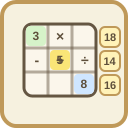
Place the digits 1-9 into the 3x3 board so every digit is used exactly once and all 3 row equations plus all 3 column equations match their target numbers.

Players: 1P Session length: 2-10 min
PuzzleNumber

Goal & Core Rules

Place the digits 1-9 into the 3x3 board so every digit is used exactly once and all 3 row equations plus all 3 column equations match their target numbers.

  • The playable board is always 3x3, and the nine number cells together must use 1 through 9 exactly once.
  • Each row reads as a 3-number equation with two fixed operators between the cells, and the target at the right is that row's answer.
  • Each column works the same way, with fixed operators between cells and a target shown below the column.
  • This build uses normal arithmetic order, so multiplication and division are calculated before addition and subtraction.
  • Difficulty changes clue density and operator mix, not board size: easy starts with more givens, while hard and expert reveal less and use more x/divide lines.

Current implementation: 3x3 once-each board

This version is a compact 3x3 puzzle. You must place all digits from 1 to 9 exactly once across the full board, so the digit pool is shared by every row and column at the same time. That makes digit tracking just as important as checking the arithmetic.

Current implementation: normal arithmetic order

This build follows the usual school rule order: multiplication and division go before addition and subtraction. Some casual equation-grid variants are read strictly left to right, which can change the answer of the very same line. If a line looks wrong here, check operator priority before changing digits.

Other common rule family: reusable digits

Some CrossMath-like or classroom variants do not require a global use-1-9-once rule. They may let digits repeat, or only care whether each line reaches its target. Those versions feel more local and forgiving, while this game asks you to balance the whole board at once.

How difficulty changes here

The board never becomes bigger than 3x3 in this build. Instead, easy usually begins with about four givens, normal with about three, hard with about two, and expert with about one. Hard and expert also allow more multiplication and exact-division lines, so they usually take more checking.

Related family: number crosswords

Some related math-crossword puzzles use clue lists like a crossword instead of fixed operators between every cell. They belong to the same wider number-puzzle family, but they feel slower and more clue-driven than this quick board-first format.

Controls

Mouse

  • Click a number cell to select it, then click a digit on the on-screen keypad to place it.
  • Click the same cell again to clear the selection.
  • Use the top menu for Hint, Restart, New Game, Export, Load, Help, or returning to the hub.

Keyboard

  • Arrow keys: move the current selection
  • 1-9 on the main keyboard or numpad: place a digit
  • 0 / Backspace / Delete: clear the selected cell
  • Esc: clear the current selection

Touch

  • Tap a number cell to select it, then tap a digit on the bottom or side keypad.
  • Tap Hint to fill one correct empty cell or fix one wrong entry.
  • Use the top menu for Restart, New Game, Export, Load, Help, or returning to the hub.

Beginner Tips

  • Start by checking which digits are already given and which digits are still missing from the board.
  • When a row or column already has two filled cells, test only the remaining unused digits that can still hit the target.
  • If a digit is already used elsewhere, stop trying to place it again. Global repeats are not allowed in this version.

Advanced Tips

  • Look at rows and columns together. A digit that fixes one line but creates a duplicate somewhere else is not the answer.
  • On hard and expert, treat division lines as exact whole-number divisions only. Fractions are not valid in this build.
  • If you get stuck, focus on the line with the strongest mix of givens, a tight target, and multiplication or division. That line usually collapses first.

Origins & History

This exact 3x3 once-each format is a modern app-style descendant rather than a single old paper-and-pencil standard. Older number crosswords already existed in the cross-figure family, while Kakuro later became widely known as a mathematical crossword built around number clues and grid logic. By the late 2000s, major media were also covering the rise of arithmetic puzzles like KenKen, showing how much wider the audience for quick number-logic games had become.

Timeline

  1. 1966 The English name "Cross Sums" was associated with Kakuro-style mathematical crosswords.
  2. 2005 The Guardian introduced Kakuro to UK readers, highlighting the appeal of number-crossword puzzles.
  3. 2009 TIME described KenKen as a possible "next Sudoku," reflecting the wider popularity of arithmetic puzzle formats.

FAQ

Do I use each digit only once on the whole board?

Yes. In this build, the full 3x3 board shares one pool of digits, so 1 through 9 must each appear exactly once across all nine cells.

Does the game calculate left to right?

No. It uses normal arithmetic order. Multiplication and division are resolved before addition and subtraction.

What changes with difficulty?

The board stays 3x3 on every difficulty. Easy usually shows more givens, while hard and expert show fewer starting digits and use more multiplication and exact-division clues.

Can I save a puzzle and come back later?

Yes. Use Export from the top menu to create a code. You can load that code again from the game's Load menu or from the hub's Load button.

Related Games